Schmiersuff
Der goldene HandschuhSchmiersuff names the mental fog produced by heavy drinking: it smears over the head and thought until clear perception gives way to muddle, exhaustion, and brief spells of sleep. The expression matters not simply as a description of drunkenness but as a recurring measure of how alcohol narrows life for Fiete Honka and Gerda Voss. A rare sober day, by contrast, lets Fiete notice how much the haze has been hiding.
Meaning and Bodily Effects
The book gives the term a concrete introduction through Fiete’s body. After roughly sixty Sheffield cigarettes and about a liter of Fako, a mixture of Fanta and Korn in equal parts, he is tired and overcome by Schmiersuff. His chest has sunk from smoking; now his thinking, too, seems smothered. The word describes a condition that is both physical and cognitive, not a momentary loss of balance alone.
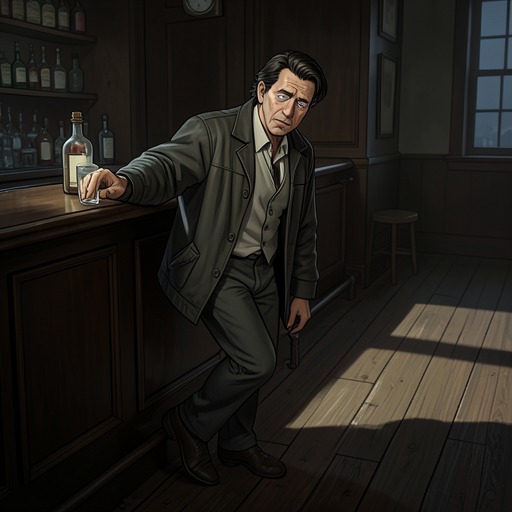
Fiete retreats to the back of the Zum Goldenen Handschuh, where the exhausted regulars sleep. He holds his head in his hands like a cut-open melon and rests it on his elbow; at the instant it settles, he is asleep. The sleep arrives suddenly and lasts no more than an hour. When he wakes, one of the sleepers is trying to take his shoes. Half-asleep, Fiete kicks out and hits him; the man falls and cuts his hand on a shard of glass. The episode places the haze inside the bar’s routine of depleted bodies, uneasy sleep, and abrupt physical incidents.
Fiete and the Lost Measure of Perception
The term’s force becomes especially clear when Fiete later walks sober to the Hamburg Landungsbrücken. He realizes that he takes in far more than when hungover or drunk, and recognizes Schmiersuff as what has been smearing everything over. The insight is prompted by ordinary sights: a disused swimming pool with cracked concrete, a broken kiosk and a littered lawn; a man without arms or legs painting the harbor with a brush held in his mouth. Sober, Fiete can pause over what he sees and assess the painter’s skill. The contrast shows the haze as a loss of attention and apprehension, not merely a hangover’s discomfort.
That clarity does not amount to a cure or a lasting change. Fiete’s excursion gives the reader a brief comparison between intoxicated and sober perception, while the habitual drinking remains part of the life surrounding him. Schmiersuff thus marks a degraded baseline against which even a single day of alertness feels newly revealing.
Gerda’s Drinking and Constricted Time
Gerda’s experience gives the expression a different scale. Her days have narrowed to hours, quarter-hours, and minutes spent enduring pain, fear, cold, and misery. As she drinks, she clings to memories, which become brighter and more sustaining than her present circumstances. The passage names Schmiersuff during this tightly managed stretch of time: at half past one, Gerda drinks her second glass more slowly than the first, then refills a Schinkenhäger bottle with water.
Her drinking is measured rather than an uninterrupted bout. She has calculated when to finish two glasses and when she can sleep before Fiete returns from work; she also plans to use cough pastilles to disguise the smell of alcohol. The calculations give her small intervals of control, but they take place within dependence and fear. She prepares herself for the possibility that her situation will worsen and imagines that she may eventually look back on the hunger and beatings as bearable by comparison. The haze belongs to a life organized around enduring the next stretch of time, not escaping it.
Drinking as Control and Survival
An earlier episode makes the stakes of drinking between Fiete and Gerda more explicit. After a walk to the fish auction hall, they return to the apartment and drink Fako in a destructive binge. Gerda has no money; that evening Fiete takes her identity card, saying he needs it for safety and as security. The next morning he locks her inside before leaving for work. The book does not label this particular episode Schmiersuff, but it shows how drinking accompanies the loss of her freedom and how dependence can coexist with coercion.
Across these scenes, the word gathers more than one kind of consequence. For Fiete, it blunts his awareness and sends him into short, sudden sleep amid the bar’s disorder. For Gerda, it enters a routine of rationing, concealment, painful memory, and restricted choices. The sober walk at the harbor makes the expression’s perceptual meaning visible; Gerda’s counted glasses show how the same haze can inhabit a longer, more constrained struggle. Schmiersuff is therefore both a bodily state and a recurring sign of lives narrowed by alcohol, in which moments of clarity or control remain brief and precarious.